Buyer's Guide · Site Feasibility
Can Your Arizona Venue Host Professional Fireworks? A Site Feasibility Checklist
The fastest way to learn whether an Arizona fireworks idea is realistic is not to start with show length or shell count. Start with the exact venue address. A professional display needs a workable firing position, controlled separation from guests and structures, access for the crew and vehicles, an approval path with the local authority having jurisdiction, and conditions that remain acceptable on show day. A beautiful venue can still be a poor fireworks site, and a modest open property can sometimes be excellent.
Start with the exact address, not the event type
Weddings, school events, HOA celebrations, corporate parties, and civic programs each carry their own logistics, but permit authority does not follow the event type. It follows the ground you intend to fire from. Arizona law allows local governing bodies to regulate supervised public displays, and in practice the local fire department or fire marshal — the authority having jurisdiction, or AHJ — reviews the operator, the location, and how the product will be handled.
That distinction matters more than most planners expect. A resort ballroom lawn inside city limits and a ranch property a mile outside those limits can be reviewed by entirely different offices with different forms, fees, and lead times. Sites in unincorporated areas typically fall to county processes instead of a municipal fire department. Before anything else, confirm which jurisdiction the property actually sits in.
Our Arizona display permits guide walks through how that approval process works, and our service areas show where we regularly produce shows across Arizona and the surrounding region.
Is there enough open space for the firing area and fallout zone?
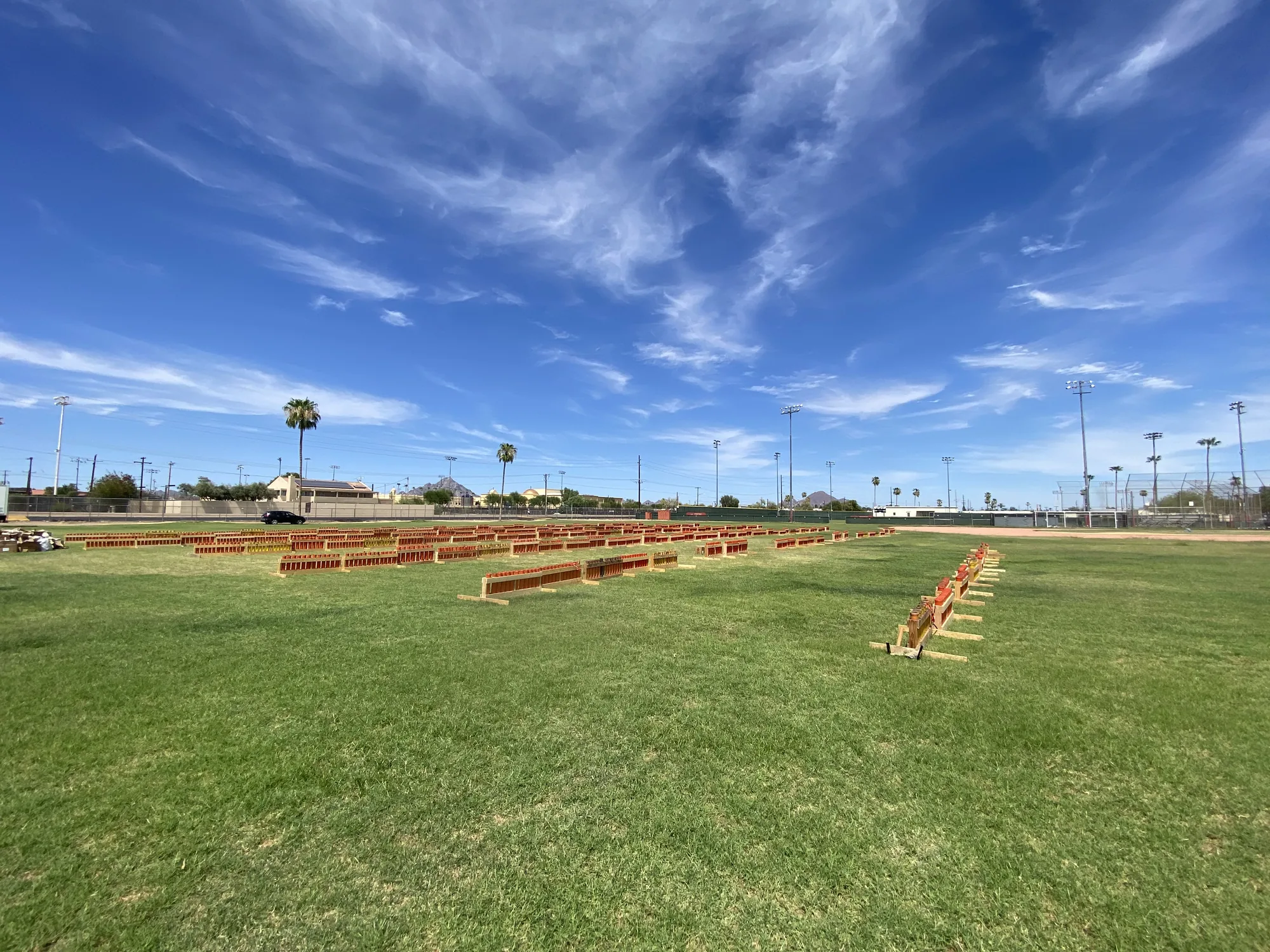
A professional display needs two kinds of space: the firing area where equipment is set, and the surrounding area where spent material and debris can fall without reaching people or property. Everything inside or near that footprint is part of the evaluation — guests and viewing areas, buildings, parking lots, roads, mature trees, overhead utilities, livestock, fuel storage, and neighboring occupied property.
The single largest effect in the design generally drives how much space is required. That is why two properties of the same acreage can support very different shows: one may have a clean, unobstructed interior with viewing held to one side, while the other has structures on three edges and a road on the fourth.
We deliberately do not publish a universal distance formula here. The governing distances come from the applicable code and the AHJ's review of your actual site plan and the specific product being fired, and they can be adjusted based on conditions. Anyone quoting you a fixed setback number without seeing the site is guessing. For background on how product choice and space interact, see how shell size shapes a show and our shell size reference.
Shell size is a site decision, not just a creative decision
Planners often arrive with a visual reference in mind — the big, high breaks they remember from a stadium or a city show. Larger shells do deliver that scale, but they also raise what the property must provide. Break height, spread, and debris footprint all grow with diameter.
A site that cannot support large aerial shells is not automatically out of options. Smaller-shell designs, low-level effects, and other professional formats can produce a dense, well-choreographed show at close range, where permitted and appropriate for the site. Intimate venues frequently look better this way, because the audience is close enough for detail to register. That is often the right approach for Arizona wedding fireworks, where the ceremony site and guest areas are fixed before the display is ever discussed.
The most reliable way to design a show is backward from the property: establish what the site and the AHJ can support, then build the display inside that envelope.
Does the venue or property owner actually allow professional fireworks?
Venue permission and fire permits are two separate approvals, and one does not imply the other. A jurisdiction may be willing to review a display at a property whose owner prohibits fireworks outright through policy, lease terms, insurance requirements, or HOA governing documents. That question should be asked in the first conversation with the venue, not after a show has been designed.
- Confirm in writing whether the venue permits professional displays.
- Identify property boundaries and who owns the adjacent parcels.
- Ask whether guest areas, parking, or vendor space can be relocated.
- Ask what insurance documentation the venue requires from vendors.
If a hotel, resort, golf course, or private estate has hosted professional displays before, that history is genuinely useful — it usually means a workable firing position exists and the venue understands the process. It does not carry over as approval for your event, date, or design. We work through these questions regularly with resorts and casinos, HOA communities, and corporate event teams.
What permit timeline applies here?
Arizona Revised Statutes §36-1603 states that an application for a public display permit is made in writing not less than five days before the display. Treat that as a statutory floor, not a planning target — local procedures routinely require substantially more lead time.
- Phoenix currently applies a special-event late fee when an outdoor pyrotechnic or fireworks application is submitted fewer than 10 City business days before the event.
- Maricopa County instructs applicants for fireworks display permits to submit at least 30 days before the event.
- Scottsdale requires permits for professional and commercial fireworks and currently lists a rush fire-permit rate for applications submitted under 10 days out.
Where practical, start venue and permit review 60 to 90 days ahead — earlier for complex sites, multi-position shows, or peak dates around the Fourth of July, when both crews and fire-authority staff are heavily booked. Deadlines, fees, and review practices vary by jurisdiction and change over time, so verify current requirements with the AHJ for your address rather than relying on the examples above.
Access matters more than buyers expect
A site can be geometrically fine and operationally difficult. The crew needs a safe vehicle route to the firing position, a way to deliver and stage equipment, the ability to secure the firing area from guests and staff for the entire load-in, and enough time for inspection, setup, the show, and post-show cleanup.
- Tight loading docks, narrow service roads, or soft turf after irrigation
- Guest or vendor traffic routed through the intended firing area
- Locked gates with no after-hours contact
- Slopes, drainage, rooftop obstructions, and overhead power lines
- Curfews or limited nighttime access for cleanup
These details rarely stop a show on their own, but together they can turn a theoretically viable site into a poor operational one — or add cost and time that are easier to plan for than to absorb late.
Fire restrictions, wind, and site conditions can change the answer
Feasibility and show-night go/no-go are separate decisions. A site can be permitted and still be wrong on the night: sustained wind, lightning in the area, heavy rain, dry vegetation loading, or a direction from the fire authority on scene can all change what happens. Arizona's dry season adds another layer, since restrictions can tighten between the day you book and the day you fire.
Phoenix changed its fireworks restrictions effective June 20, 2026, and professional displays remain allowed through the permit process — a useful example of why planners should check current local conditions rather than assume last year's rules still apply. We don't promise weather outcomes or automatic rescheduling; what we do is plan the site conservatively and keep the fire authority in the conversation. See our safety and compliance overview for how that framework works on our shows.
Special locations can trigger extra coordination
Some properties are workable but require approvals beyond the local fire permit. OSHA's professional display guidance specifically identifies examples such as FAA approval near airports and heliports, Coast Guard approval for harbors and navigable waterways, road and access control, approvals from the authority having jurisdiction, fire and EMS coordination, and insurance requirements.
Not every event needs every one of these. What matters is identifying early whether your address sits near an airport or heliport, on or beside water, along a road that may need closure, on public parkland or city-owned property, within a dense residential area, on Tribal land, or adjacent to unusual structures. Displays on Tribal land follow sovereign processes, which we cover in producing displays with Tribal Communities.
A quick venue-feasibility checklist
Gather this before your first serious conversation with a display company. It is enough for an experienced producer to give you a candid early read.
Bring this to the first conversation
- Exact venue name and street address
- Event date and proposed firing time
- Guest count and planned guest/viewing areas
- Property map or aerial view if available
- Venue or property-owner contact
- Any known venue fireworks policy
- Approximate open area available for firing and fallout
- Nearby buildings, roads, parking, trees, utilities, and neighboring property
- Whether professional fireworks have been produced there before
- Desired display style and approximate budget
- Any fixed event schedule constraints
- Any known city, county, or Tribal jurisdiction information
What Southwest Fireworks can tell you before a proposal
Send us the venue address, the date, and basic event details and we can screen initial feasibility, flag obvious site constraints, and tell you what further site review and AHJ coordination would be required before a final design and quote. In many cases that first read takes a short conversation and saves weeks of planning around a property that was never going to work — or confirms that a site you assumed was too small is entirely usable with a different design.
What we will not do is promise a permit outcome. Approval belongs to the authority having jurisdiction, and it is based on the site, the product, the operator, and the conditions on your date.
If you're also building a budget, our Arizona fireworks show cost guide explains what actually moves the number, and our safety page covers the compliance framework behind every display. Request a quote with your venue address and we'll start with feasibility, not a sales pitch.
Authoritative references
External resources for further reading. These sources are provided for reference and do not substitute for the authority having jurisdiction, licensed professionals, or current codes.
- Arizona Revised Statutes §36-1603 — Permit for public display — State statute on written application for supervised public displays
- City of Scottsdale — Fireworks Safety — Permit requirements for professional and commercial displays
- City of Scottsdale — Fire Permit Services — Fire permit application process and current rates
- City of Phoenix — Outdoor pyrotechnic / fireworks display permit — Application requirements and submission timing
- Maricopa County — Licenses & Permits — County guidance on fireworks display permit submission
- OSHA — Pyrotechnics Industry: Fireworks Display — Federal guidance on display site planning and required approvals
Planning a display of your own?
Share your event details and our team will follow up with a scoped conversation about what a professional display could look like at your site.