Guide · Permits & Approvals
Arizona Fireworks Display Permits: What Event Organizers Need to Know
Permitting is the part of fireworks planning organizers understand least and worry about most. Here is how approval actually works in Arizona, what a fire authority is looking at, and how to keep your date from slipping.
Who actually approves a display
Organizers often ask which state office issues a fireworks permit in Arizona. There isn't one central approval that covers every show. Authority sits with the entity that has jurisdiction over the ground you intend to fire from — commonly referred to as the authority having jurisdiction, or AHJ. In practice that is most often a municipal fire department or fire marshal's office, a county fire district or county fire marshal in unincorporated areas, or a tribal fire authority and tribal government on tribal land.
That means the requirements for a display in one Arizona city can differ meaningfully from a display twenty miles away. Application forms, fees, lead times, inspection practices, and standby apparatus expectations are set locally. Two nearly identical shows can face different paperwork simply because the property lines fall in different jurisdictions.
Federal and transport-level rules run alongside local approval rather than replacing it. Display fireworks are regulated federally as explosives, and their transport and storage are governed separately from the local permission to fire them at your venue. A qualified display company carries its own federal and transport obligations; the local permit is about your event, your site, and your date.
Southwest Fireworks handles the display-side permitting work on the shows we produce and coordinates directly with the fire authority. What we cannot do is guarantee an outcome — no display company can promise a permit will be issued, and you should be cautious of anyone who does.
Display fireworks vs. consumer fireworks
Arizona's rules around consumer fireworks — the items sold seasonally at retail stands — are a separate subject from professional display fireworks, and the two get conflated constantly in online searches. Municipalities across the state regulate consumer use, sale periods, and permissible items differently, and some restrict them heavily.
A professional display is a different category entirely: larger aerial product, fired by licensed operators from a designed firing site under a permit, with defined separation distances and a written safety plan. Reading consumer fireworks ordinances will not tell you what your community event needs. If you are hosting a public display, the conversation to have is with the fire authority about a display permit, with the display company at the table.
For a plain-language explanation of the compliance framework a professional show is fired under, see our safety, licensing, and insurance page.
Documents typically requested
The exact packet varies by jurisdiction, but most Arizona fire authorities ask for some combination of the following. Your display company should assemble the technical portions; the organizer usually supplies the event-level information.
- A completed application for the fire authority, naming the event, date, times, and responsible parties.
- A site plan showing the firing line, the discharge and fallout area, spectator lines, structures, parking, roads, and access routes — usually to scale.
- A product list identifying the largest shell size and the general inventory to be fired, since separation distances scale with shell diameter.
- Operator credentials for the lead shooter and information about the crew.
- Proof of insurance from the display company, often with the jurisdiction or venue named as an additional insured.
- A written safety plan covering crowd control, emergency access, misfire and dud procedures, and post-show site sweep.
- Landowner or venue authorization confirming permission to use the property.
Fees are set by the jurisdiction and vary. Standby fire apparatus or personnel may be required at the organizer's expense in some places, and that requirement is a real budget line — one worth confirming early rather than discovering three weeks out. We cover how items like this move a budget in our guide to what a professional fireworks show costs in Arizona.
Why the site drives the approval
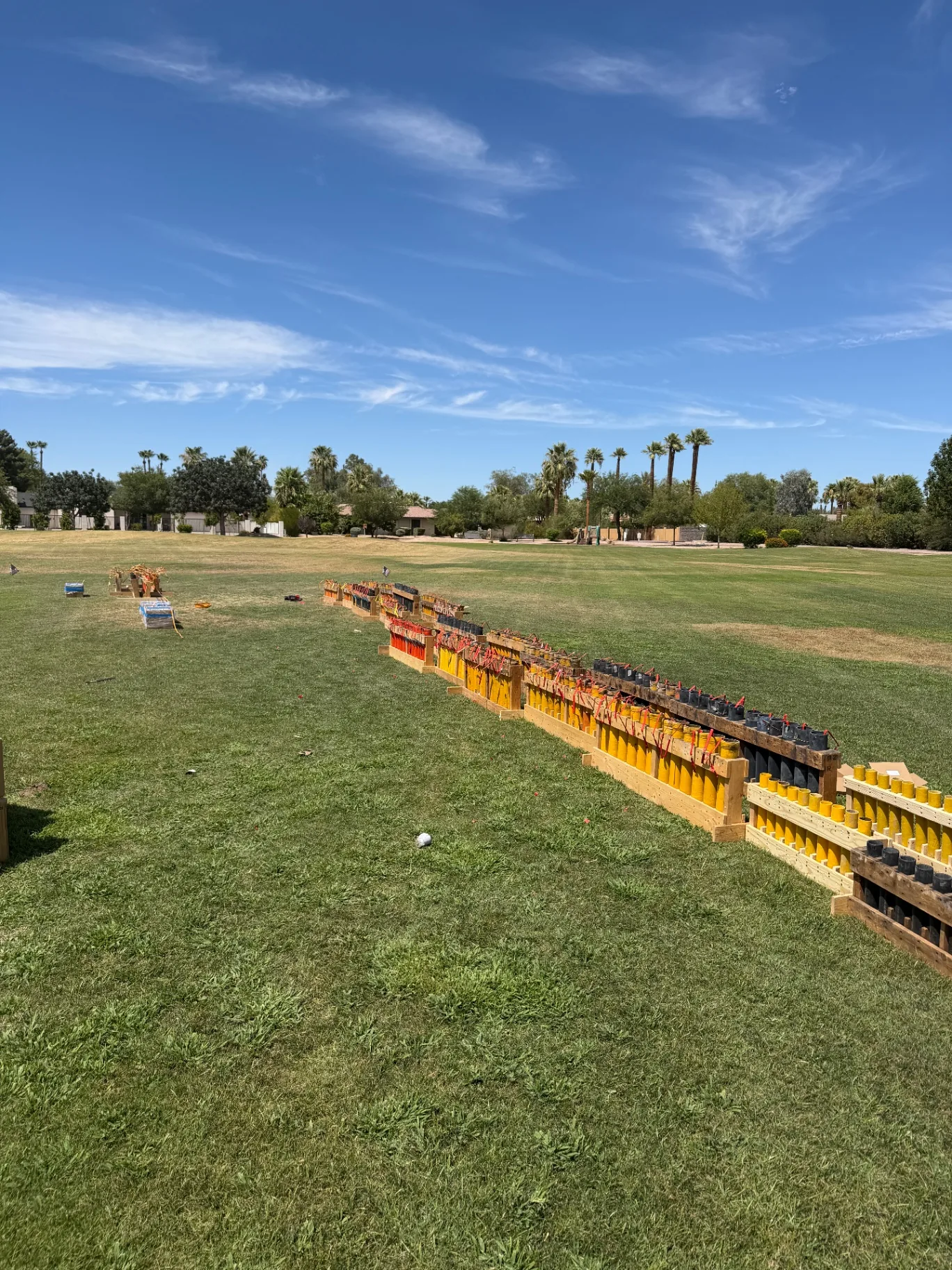
The single biggest predictor of whether a display is approvable is the site itself. Aerial shells require a clear discharge and fallout area sized to the largest shell being fired; industry code establishes minimum separation distances between the firing site and spectators, structures, and other exposures, and those distances scale with shell diameter. A site with limited open ground doesn't fail — it simply supports smaller product.
What a fire authority looks at
- Distance from the firing line to spectators, buildings, fuel storage, and roadways
- Overhead obstructions — power lines, light standards, trees, canopies, structures
- Ground fuels: dry brush, turf condition, landscaping, and adjacent open desert
- Emergency vehicle access to and from the firing site while the crowd is present
- Wind exposure and the prevailing direction on a typical evening at that location
- Water availability and suppression resources on site
If your site can't support the show you imagined, the productive move is usually to redesign the show rather than argue the site. Shifting the firing point, reducing the maximum shell size, or leaning on lower-break product and ground effects frequently produces an approvable, genuinely good display. Our shell size guide explains how diameter relates to break height and required distance, which is the fastest way to understand what your venue can hold.
Arizona fire restrictions and drought conditions
Arizona adds a variable many organizers from other states don't anticipate: seasonal fire restrictions. State, federal, county, and tribal land managers may implement restrictions during periods of elevated fire danger, and those restrictions can affect open flame, fireworks, and related activity on the lands they govern. Status changes through the season based on conditions, and it is published and updated by the responsible agencies.
For display planning this has two practical consequences. First, sites near or on wildland-interface ground carry more condition risk than a groomed, irrigated venue surrounded by pavement — a stadium field, golf course, resort lawn, or lakefront often presents a cleaner picture than open desert. Second, your plan should include a documented contingency: what happens if conditions on the week of the show force a change. Discuss this with the fire authority when you first apply, not after conditions shift.
Monsoon season introduces the other Arizona wrinkle. Late-summer storms bring wind, lightning, and dust that can force a hold or a call on show night regardless of any permit. That's a weather decision, not a permitting one, but it belongs in the same conversation because the answer affects your rain date and your public communications.
A realistic Arizona planning timeline
Lead times differ by jurisdiction, and some accept applications on short notice. Working backward from a comfortable margin rather than the minimum is what protects your date — especially for July programs, when crews, product, and licensed operators across the industry are committed months ahead.
Six to twelve months out
- Lock the date and the venue; identify who has jurisdiction over that exact parcel
- Engage a display company and get an honest site read before promoting the event
- Confirm budget expectations, including any standby or permit fees the jurisdiction may impose
Three to six months out
- Walk the site with the display company and, where offered, the fire authority
- Settle the show design and maximum shell size against the site's available distances
- Assemble the application packet: site plan, product list, insurance, safety plan, venue authorization
Six to twelve weeks out
- Submit the application and respond quickly to any requests for revision
- Confirm standby requirements, road closures, and law enforcement coordination
- Finalize the rain date or postponement policy and how you will communicate it
Show week
- Confirm current fire restriction status and the forecast
- Coordinate setup access, secure area timing, and the inspection window
- Brief venue staff, volunteers, and security on the safety perimeter
Tribal lands and other jurisdictions
Displays on tribal land are approved under tribal authority. Tribal nations are sovereign, and their processes, timelines, and points of contact are their own — they are not a variation of a city process. Coordination is often relationship-driven and benefits from starting earlier than a comparable municipal show, with respect for cultural protocol and internal review cycles. We describe how we approach that work in our field notes on producing displays with tribal communities and on our tribal communities page.
Other site types bring their own overlays. Shows on or near federally managed land, state trust land, waterways, airports, or school district property can involve additional landholders or agencies beyond the fire authority. Identifying every stakeholder in the first month is far cheaper than discovering one in the last.
Venue, landowner, and third-party approvals
A fire authority permit is permission to fire; it is not permission to be on the property. Organizers regularly need parallel sign-offs that have nothing to do with the fire department:
- Property owner or venue management authorization, often with its own insurance requirements
- School district, resort, casino, or HOA board approval depending on the host
- Municipal special event or assembly permits for the gathering itself
- Noise ordinance or curfew considerations, which frequently set the latest possible start time
- Road closure and traffic control approvals, and law enforcement coordination for larger crowds
For community and neighborhood settings, curfews and resident notification tend to shape the schedule more than anything else. Our HOA and community planning guide walks through that in detail.
Inspection and show-day coordination
Many jurisdictions inspect the site before the show is authorized to fire. Setup typically begins hours before the audience arrives, with the crew establishing the firing line, placing and securing racks, running the firing system, and establishing the secured perimeter. The inspector generally wants to see the layout matching the approved site plan, the perimeter maintained, product handled and covered appropriately, and the crew's readiness.
What organizers can do to make that go smoothly is mostly logistical: guarantee vehicle access to the firing area, keep vendors and staff out of the secured zone once it's established, make sure whoever controls gates and keys is reachable, and designate a single event contact who can make decisions during the show window. Late-arriving vendors parked in a fallout zone is a real and recurring problem.
Postponement, cancellation, and re-approval
Decide who makes the call and by when, and write it down before show week. Weather holds are normal in Arizona; the crew, the fire authority, and the organizer should share the same understanding of the criteria for a hold, a delay, or a cancellation.
If the show moves to another date, confirm with the fire authority what that requires — depending on the jurisdiction, a permit may be tied to a specific date, and moving may require notification, an amendment, or a new approval. Ask that question when you apply so the answer is already in hand when you need it.
Common mistakes that delay approval
- Promoting the event publicly before the site has been assessed for feasibility
- Choosing a venue for its parking or aesthetics without checking available separation distance
- Assuming a neighboring city's requirements apply to yours
- Submitting a site plan without dimensions or without spectator lines drawn
- Leaving standby apparatus costs and permit fees out of the budget
- Overlooking a second approving party — venue, school district, land manager, or road authority
- No documented weather-decision process and no rain-date plan
Organizer checklist
- Confirm exactly which authority has jurisdiction over the firing parcel
- Get an honest site read from a display company before announcing the event
- Match maximum shell size to available separation distance, not to preference
- Assemble the application packet early: site plan, product list, insurance, safety plan
- Budget for permit fees and any standby personnel or apparatus requirement
- Secure venue, landowner, and any district or board approvals in parallel
- Verify curfew and noise limits before publishing a start time
- Track current Arizona fire restriction status through show week
- Document the weather-decision authority, criteria, and rain-date policy
- Confirm setup access, inspection window, and a single reachable event contact
Where to go from here
Permitting is far less intimidating when the site work happens first. Once a display company has read the site and told you honestly what it can support, the application usually describes a plan the fire authority can approve rather than one it has to negotiate. Nothing here is legal advice, and requirements change — your fire authority is always the definitive source for your event.
You can see the range of venues we've worked across in the show gallery, check where we operate on our service areas page, or browse what we produce. When you have a date and a venue in mind, request a quote and we'll scope the site and the approvals with you — or contact the team if you just want a first read on feasibility.
Authoritative references
External resources for further reading. These sources are provided for reference and do not substitute for the authority having jurisdiction, licensed professionals, or current codes.
- NFPA 1123 — Code for Fireworks Display — Industry code covering outdoor aerial displays and separation distances
- Arizona Department of Forestry and Fire Management — Fire Restrictions — Current statewide restriction status by land manager
- ATF — Fireworks — Federal framework governing display fireworks
- US DOT PHMSA — Hazardous Materials Transportation — Federal rules for transporting display product
- Arizona Revised Statutes — Primary source for current Arizona statutory language
Planning a display of your own?
Share your event details and our team will follow up with a scoped conversation about what a professional display could look like at your site.